A thesis by Arya Shah · Independent research
Deskless AI
The zero-onboarding enterprise layer for frontline workers.
Eighty percent of the global workforce does not sit at a desk. They keep planes moving, packages flowing, and warehouses stocked - and the software built for them is software they never open. The thesis: meet them where they already are. SMS and iMessage AI agents that read and write to the systems of record, with nothing to install and nothing to learn.
Enterprise software was built for the desk. The frontline got left behind.
Slack, Teams, and Salesforce assume a laptop, a login, a training session, and a quiet moment to navigate a dashboard. A baggage handler on a ramp, a driver mid-route, a supervisor on a loading dock has none of those. So adoption stalls, seats go unused, and the work that actually happens never makes it into the system of record. The gap is not a feature gap. It is an interface gap.
Apps the frontline never opens
- Requires a managed device, an install, and a login
- Onboarding and training before anyone is productive
- Per-seat licensing on workers who log in once a quarter
- Adoption stalls; real work stays on paper and in heads
An agent that lives in the text thread
- Works on any phone - the Messages app is the whole client
- Zero onboarding: if you can text, you can use it
- Reads and writes the systems of record in plain language
- Reliable offline-first delivery; nothing to forget to open
The whole product is a text message.
Pick a frontline scenario. The worker texts in plain language; the agent parses it, writes to the system of record, and texts back a confirmation - the same loop, whether it is a torn bag tag, a blocked route, or a bad pallet count.
Three properties the desk-bound stack can't match.
Zero onboarding friction
No app to install, no account to provision, no training to schedule. The worker texts a number and is productive on minute one. IT keeps its existing systems; the agent speaks to them.
Instant database reads & writes
The agent translates plain language into typed actions against the ERP, WMS, or routing system - and reads back the same way. The text thread becomes a live, two-way interface to the system of record.
Offline-first reliability
SMS degrades gracefully where data apps fail: a ramp, a basement dock, a rural route. Messages queue and deliver, so the report still lands when connectivity is thin.
The defensible part isn't the chat. It's the write layer.
A clean text interface is easy to demo and easy to copy. The real moat is the system-of-record write layer: reliably executing complex, multi-step state mutations into legacy systems - ERPs, TMSs, WMSs - over a channel as thin and lossy as SMS. That is where the hard engineering lives, and where invisible software earns trust. If a write silently fails, the worker stops texting, and the whole thesis collapses.
- 01
Parse intent from thin text
Turn one ambiguous, unstructured message into a precise, typed action - resolving the SKU, the flight, the stop, the dock.
- 02
Plan the multi-step mutation
A single report often means several ordered writes across an ERP or TMS: create the record, update the count, re-sequence the route, fire the notification.
- 03
Execute reliably over SMS
Commit the sequence transactionally against brittle legacy APIs, with retries, idempotency, and a confirmation that the worker actually receives.
Anyone can ship a bot that replies. Very few can guarantee that “dock 4 is 14 pallets, not 12” lands as a correct, reconciled write in the ERP every single time, from a basement loading dock, on the first try. That reliability is the product.
A whole ecosystem is converging on the text thread.
The deskless thesis is one edge of a broader shift: the most usable interface for AI is the one already on every phone. Justine Moore's iMessage market map traces the same idea on the consumer side - the invisible software pattern, where the product has no UI of its own and just answers a text. Two layers are forming: assistants that do the work, and the infrastructure that carries the messages.
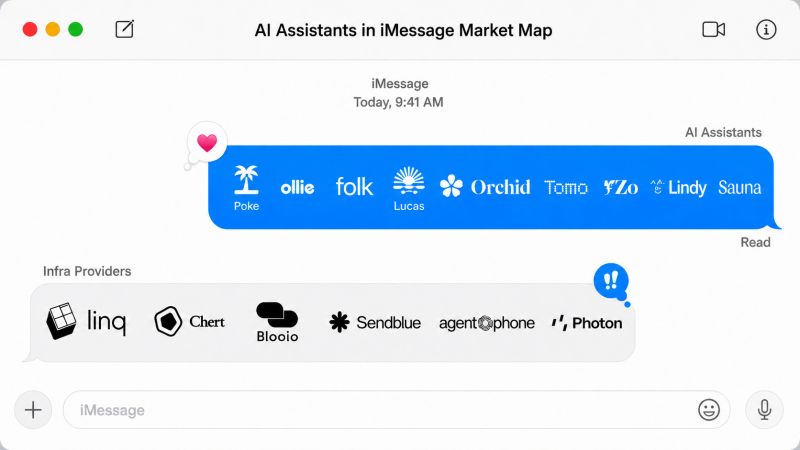
Assistants
Agents that live in the thread and do the work - scheduling, reminders, research, follow-ups - without ever asking you to open an app.
- PokeGeneral-purpose personal assistant over text
- OllieProactive daily-life assistant
- FolkRelationship and contact follow-ups by text
Infrastructure
The plumbing that lets any product send and receive iMessage and SMS at scale - the rails the assistants ride on.
- LinqiMessage and contact identity rails
- SendblueiMessage API for sending and receiving
Read the same way for the frontline: the assistants become the operational agent on the ramp or the dock, and the infrastructure is the carrier that reaches a worker who never installs anything. Same invisible software, pointed at the 80%.
Others bolt a dashboard on. We stay headless.
Other teams are reaching the frontline too - and that validates the market. But most pair the text channel with a dashboard, an admin console, or a heavier tool the team still has to adopt and learn. Every extra surface is friction, and friction is exactly what keeps software off the frontline. The headless approach goes the other direction: absolute invisibility, no interface to onboard.
Text in, but a tool to learn
- UdextTexting layer paired with manager dashboards and analytics consoles to monitor the frontline.
- SidekickHeavier task and workflow tooling that still asks teams to adopt and learn a new surface.
No dashboard. No console. Just the thread.
- Zero friction: nothing new to open, log into, or be trained on
- An absolute invisible interface - the work happens in Messages
- The depth lives in the write layer, not in a UI nobody uses
- Managers get reconciled records, not another app to babysit
What zero-friction logging is worth at scale.
Frontline teams lose real time to paperwork and double-entry. Estimate the time the agent reclaims by capturing the report at the moment it happens, in one text.
Assumes the agent removes 70% of daily logging time over 250 workdays, at a fully-loaded $32/hr. An estimate for discussion, not a quote.
Discuss this thesis
If the frontline is the next enterprise interface, let's talk.
This is independent research by Arya Shah. If you are building for deskless workers, living the problem as an operator, or just want to argue the other side, the thesis is meant to be pressure-tested. Share it and start the conversation.
Independent research by Arya Shah